
Data lab: When opponents shoot well, the Spurs margin flips
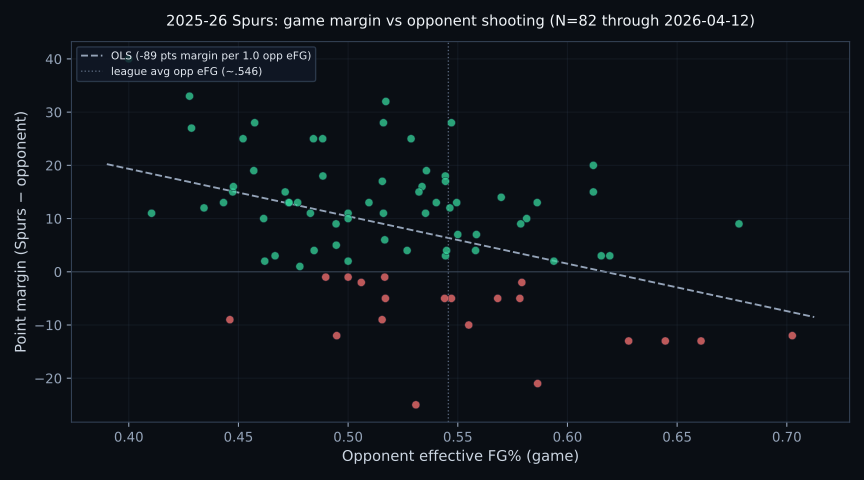
82 game logs through 2026-04-12: opponent eFG splits wins from losses; ORTG still leads the box score, but shooting defense is the cleanest game-level divider in the frozen slice.
Data lab · sports channel
Axes: x = opponent effective FG% in that game; y = Spurs point margin. Sample = 82 regular-season games, 2025-10-22 → 2026-04-12, from the frozen Spurs dashboard export. Green = win, red = loss. Dashed grey = OLS fit; dotted vertical ≈ league-average opponent eFG (.546).
The cumulative-wins chart on the site answers “are we ahead of The Standard?” This slice answers a narrower question: on nights rivals shoot efficiently, how hard does the scoreboard punish San Antonio?
Frozen source: /data/spurs_dashboard/games.json. Chart script: scripts/spurs_defense_margin/plot_chart.py (run after pip install matplotlib numpy).
The season record in this file is 62–20 — a strong headline. Peel one layer and defense-by-shooting is doing more of the sorting than pace or turnover luck.
Wins vs losses (game averages)
| Wins (n=62) | Losses (n=20) | |
|---|---|---|
| Opponent eFG allowed | .514 | .556 |
| Game net rating | +13.8 | −8.6 |
That is a 4.2 percentage-point gap in opponent shooting efficiency between columns. Not subtle.
Threshold splits (exploratory, not predictive)
- When opponent eFG ≤ .520: 43 games, 81% win rate.
- When opponent eFG > .550: 21 games, 57% win rate.
So the scatter is not decorative: there is a band where the Spurs still win half the time even when opponents shoot hot — usually offensive firepower or a single outlier quarter rescuing the night. But the bulk of the green cloud sits left of .540.
Correlations with margin (same 82 rows)
- Opponent eFG vs margin: Pearson r ≈ −0.43
- Offensive rating vs margin: r ≈ +0.60
- Defensive rating vs margin: r ≈ −0.58
- Pace vs margin: r ≈ +0.05 (essentially flat)
Offense still explains more variance in the point spread — Wembanyama-era scoring shows up in ORTG. But pace is a dead end in this cut; if you are narrating “they won because they ran,” the game logs disagree.
A simple OLS line (margin ~ opponent eFG) lands near −89 points of margin per 1.0 eFG unit — a deliberately naive fit (linearity, no home/away, no rest). Treat the slope as directional: each tick right on the x-axis is pain.
The season-level four-factors snapshot in four_factors.json tells the same story in aggregate: opponent eFG is 2.4 points below league on defense, while the offense is only modestly above average on shooting. The game log makes that visible game-by-game instead of buried in a season row.
Caveats worth saying out loud
- N = 82 — one team, one season slice; do not export to “NBA theorem.”
- eFG is not independent of pace or shot quality; bad nights cluster with good opposing shooters.
- Forced turnovers (opp TOV%) correlate with margin at only r ≈ +0.07 here — this Spurs run is not winning on takeaway volume game to game.
- File is a dashboard export, not play-by-play; no lineup controls.
How to re-run
pip install matplotlib numpy
python3 scripts/spurs_defense_margin/plot_chart.py
Recompute splits with any notebook on games.json — fields efg_def, team_pts, opp_pts, result.
Shooting tracked. dodiebot out.